
Security Infrastrucutre

Zero Trust & Secure Access Service Edge (SASE)

Secure and controled access for the modern distributed workforce

Zero Trust & SASE: Secure access for the modern borderless organisation

Modern security no longer sits at the perimeter. Apstorm helps CISOs design and implement Zero Trust and SASE architectures that protect users, data and applications wherever they operate. We translate strategy into enforceable controls, combining identity, endpoint, network and cloud security into a cohesive, risk-aligned architecture that supports hybrid work and cloud transformation without compromising resilience.

We design, implement and optimise scalable IAM frameworks that reduce identity risk, strengthen compliance and streamline user lifecycle management, without adding operational friction.

Expanded attack surface leaves organisations exposed

Traditional perimeter-based security models assume trust inside the network. That assumption no longer holds.

Your workforce is distributed. Applications sit in SaaS platforms and public cloud. Third parties require controlled access. Devices operate across untrusted networks. Each user becomes what our white paper describes as a “microsystem” within a broader ecosystem.

For CISOs, this creates strategic challenges:

  • Expanding attack surface due to remote work and cloud adoption

  • Credential theft and phishing as primary compromise vectors

  • Limited visibility across SaaS, endpoints and third-party access

  • Difficulty enforcing least privilege consistently

  • Fragmented tooling across IAM, CASB, VPN, EDR and SIEM

  • Pressure from regulators and boards to demonstrate resilience

Zero Trust is often marketed as a product. In reality, it is an architectural shift that must align with business risk, technical maturity and budget constraints.

SASE promises convergence, but without careful design, organisations risk vendor lock-in, capability gaps or operational complexity.

Zero Trust / SASE - Vendor neutral architecture - built around your risk profile

Apstorm delivers Zero Trust and SASE as a structured transformation programme, not a technology purchase. Drawing on the six core Zero Trust pillars outlined in our vendor-independent framework, we design architectures that:

  1. Manage identity, authentication and access

  2. Secure network traffic across untrusted environments

  3. Enforce least privilege

  4. Protect endpoints, networks and applications

  5. Monitor behaviour and detect anomalies

  6. Automate response and incident handling

We align this model with SASE principles, converging:

  • Secure web gateway

  • CASB capabilities

  • SD-WAN network management 

  • Cloud firewall controls

  • Identity-centric policy enforcement

  • Integrated monitoring and response


How Apstom Helps with Zero Trust and SASE

  • 20+ years of industry expertise

  • Independent advisory model

  • No vendor bias or quota-driven design

  • Senior consultants delivering real implementation

  • Friendly, pragmatic engagement style

  • Flexible engagement models: advisory, project, managed

We combine strategic clarity with operational execution.

Zero-Trust / SASE - Key Benefits

Identity-Led Security at Every Access Point

By shifting trust decisions to identity, context and device posture, you reduce reliance on legacy perimeter controls. Every user, device and session is verified continuously, limiting credential abuse and lateral movement.

Converged Network & Security Through SASE

SASE unifies SD-WAN, secure web gateway, CASB, Zero Trust Network Access and cloud firewall controls into a coherent, cloud-delivered model. By converging connectivity and security within a single architectural framework, organisations reduce infrastructure sprawl, simplify policy enforcement and ensure consistent protection across branch offices, remote users and cloud environments.

Reduced Attack Surface 

By enforcing least privilege, segmenting access and protecting endpoints, you shrink the organisation’s exploitable footprint. Compromised credentials or devices cannot easily propagate risk across the estate.

Continuous Visibility & Behavioural Insight

Integrated monitoring across endpoints, network traffic and cloud services enhances detection of anomalous behaviour, insider threats and account compromise. Security leaders gain real-time insight rather than retrospective logs.

Faster, Safer Remote & Third-Party Access

Secure, encrypted tunnels and cloud-delivered controls protect users operating across untrusted networks. Third parties can be granted tightly scoped access without exposing core infrastructure.

 Policy Consolidation Efficiency

Converged SASE architecture reduces duplicated tooling, simplifies policy management and lowers operational overhead. Security teams spend less time maintaining fragmented controls and more time managing risk.

Strategic Risk Reduction

Zero Trust is not a product deployment. It is a demonstrable risk reduction programme. Structured maturity progression, from foundational controls to advanced monitoring and automation, supports regulatory scrutiny and board-level reporting.

Phased, Achievable Transformation

A maturity-based roadmap allows you to prioritise identity, endpoint and secure access controls first , delivering early risk reduction while building toward advanced automation and response.

Cloud-Native Scalability 

SASE-enabled Zero Trust architectures scale with your organisation. As you onboard new users, adopt new SaaS platforms, expand geographically or integrate acquisitions, policies extend consistently without redesigning perimeter infrastructure. Security becomes elastic, aligned to business growth rather than constrained by legacy network boundaries.

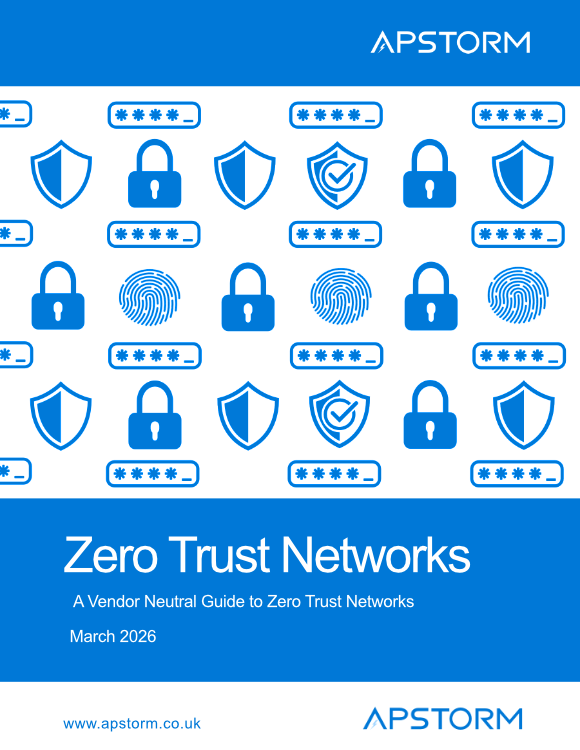
A Guide to Zero Trust Networks

This vendor-agnostic guide provides a clear, technical view of Zero Trust, helping you understand the model, assess your current position, and identify practical next steps. It focuses on real-world application rather than product-led messaging, enabling you to map existing controls, highlight gaps, and plan a structured path towards improved security maturity. Inside, we cover: Definition – What Zero Trust means in practice today Imperative – Why it has become a standard approach to modern threats Architecture – The core components and how they fit together Strategy – Key considerations for implementation and progression

How Apstom Helps with Zero Trust and SASE

  • 20+ years of industry expertise

  • Independent advisory model

  • No vendor bias or quota-driven design

  • Senior consultants delivering real implementation

  • Friendly, pragmatic engagement style

  • Flexible engagement models: advisory, project, managed

We combine strategic clarity with operational execution.

Zero Trust and SASE Includes

Identity-Centric Access Control

  • Identity Access Management integration

  • Multi-Factor Authentication

  • Single Sign On 
  • Role-based access control and least privilege modelling

  • Third-party and guest access governance

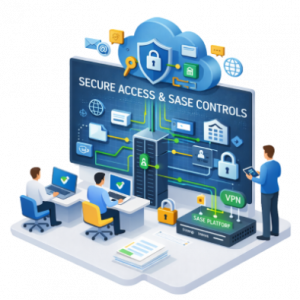
Secure Access & SASE Controls

  • Cloud Access Security Broker capabilities

  • Secure web and email filtering

  • SD-WAN replacing legacy MPLS and VPN models

  • Encrypted traffic tunnels across untrusted networks

  • Cloud firewall and security group design

Endpoint & Workload Protection

  • EDR and XDR implementation

  • Behaviour analytics and anomaly detection

  • Device posture validation and segmentation

  • Network Access Control where appropriate

Monitoring & Response

  • SIEM integration and log correlation

  • SOAR orchestration for automated response

  • Incident response planning and retainers

  • Managed monitoring options

Zero Trust Maturity Roadmap

Based on your maturity model (Entry, Intermediate, Advanced) , we:

  • Assess current state

  • Map capability gaps

  • Prioritise quick risk reduction wins

  • Build a two-year strategic transformation plan

For More Information on Zero Trust and SASE - get in touch with one of our consultants

FAQ - Zero Trust and SASE

Q1: Is Zero Trust the same as SASE?

No. Zero Trust is an architectural philosophy. SASE is a convergence model that delivers many Zero Trust controls through cloud-native platforms. We align both within a coherent design.

Not necessarily. Many organisations already have foundational elements such as MFA, endpoint security and VPN in place . We assess fitness for purpose before recommending change.

A phased roadmap over 12–24 months is typical, starting with identity, endpoint and secure access controls. However, it can be quicker depending what is already in place, it could be a case of joining up existing technology, processes, people and reporting. 

Yes, when designed correctly. Identity enforcement, logging and least privilege support regulatory compliance.

Yes. We provide managed monitoring and response options aligned to SIEM, XDR and SOAR capabilities .

For more information on Zero Trust and SASE